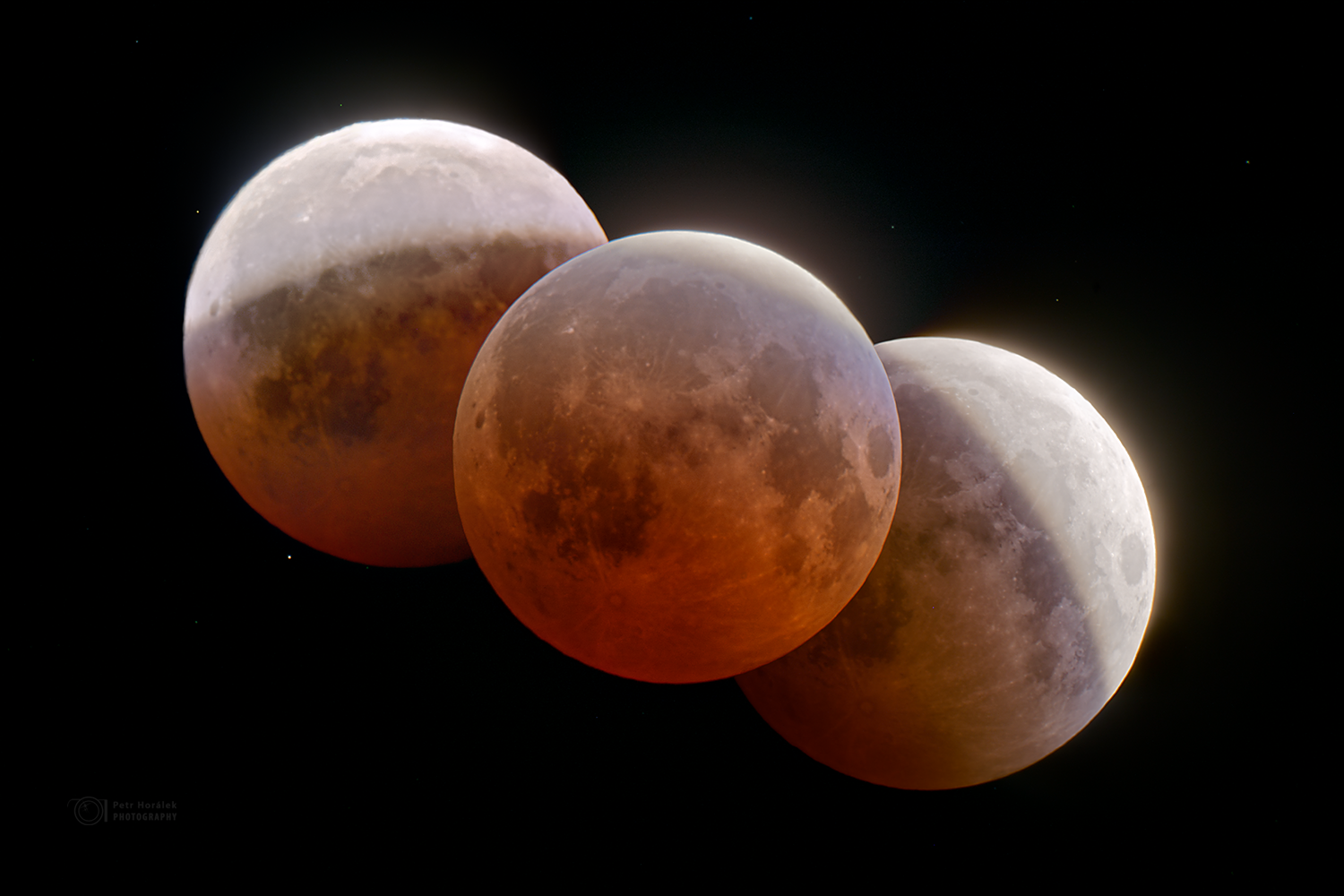
Colors in the Round Shadow
For the deep lunar eclipse on 28 August, 2026, I traveled with my friend Josef Kujal more than 1900 km (about 1180 miles) from the Czech Republic to the region of Mount Ursuya in France, where we witnessed a truly beautiful view of the phenomenon at dawn. The attached image shows the maximum phase at 4:12 UTC and the side phases +/- 36 minutes, composed precisely to the position in the shadow, so it reveals its rounded shape. The same shape Fernão de Magalhães (Ferdinand Magellan) reportedly pointed out to his sailors that during a lunar eclipse, the Earth always casts a round shadow on the Moon and thus the sail around the world cannot end on the edge of our planet. In the shadow, of course, there is not complete darkness, as the faint sunlight reaches the Moon through the Earth’s atmosphere. Also, with the blue tint caused by the ozone layer, which absorbs the red part. The ending phase (right) was very low over the horizon, so you can see very bad seeing in the shape of the Moon’s edge.
Used Nikon Z6III, 1000mm/f10 + 1,4x teleconverter, ISO 400, HDR exposures (each eclipse phase of nine exposures from 1/30s to 8s), Vixen GP-2 mount. Full credit: Petr Horálek (Institute of Physics in Opava), Josef Kujal.
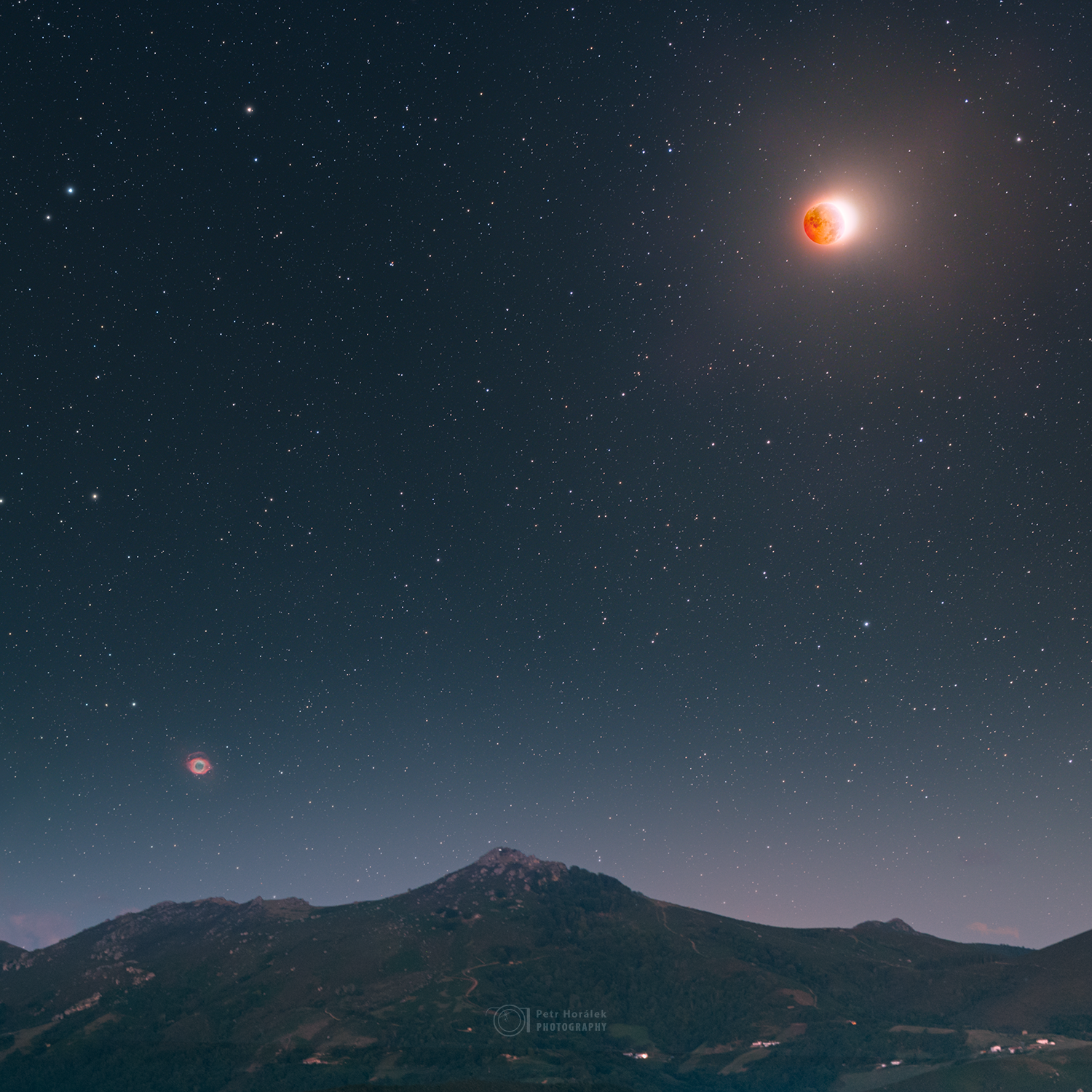
Eclipsed Moon, Helix, and Pyrenees – Detail Cut
In fact, there was more. During this lunar eclipse, the darkened Moon appeared angularly close to the well-known Helix Nebula (NGC 7293), also popularly nicknamed “God’s Eye”. This planetary nebula was formed about 12 thousand years ago by the death of a Sun-like star about 450 light-years away. It lies in the sky about 10° south of the ecliptic, i.e. the plane where a lunar eclipse can occur. But there is a catch: In order for the eclipsed Moon to lie angularly closest to the nebula, the eclipse must occur for only a few dozen hours around midnight from August 27 to 28. The last time such a situation occurred during a total lunar eclipse on August 28, 2007, and it will not occur again until August 28, 2072. This is therefore a very rare event. In the foreground of the image rises the Pyrenean mountain Pic du Mondarrin, towering 749 meters above the level of the nearby Atlantic Ocean.
Used two Canon Ra cameras on Vixen Polarie-U mounts, (1) 135mm, f1.4, ISO 1600, 58x30s (Helix in detail), (2) 70-200mm@92mm, f2.8, ISO 3200, 64x30s (wide view with eclipsed Moon, foreground). For the foreground, one 30s exposure was used with no tracking. Full credit: Petr Horálek (Institute of Physics in Opava), Josef Kujal.
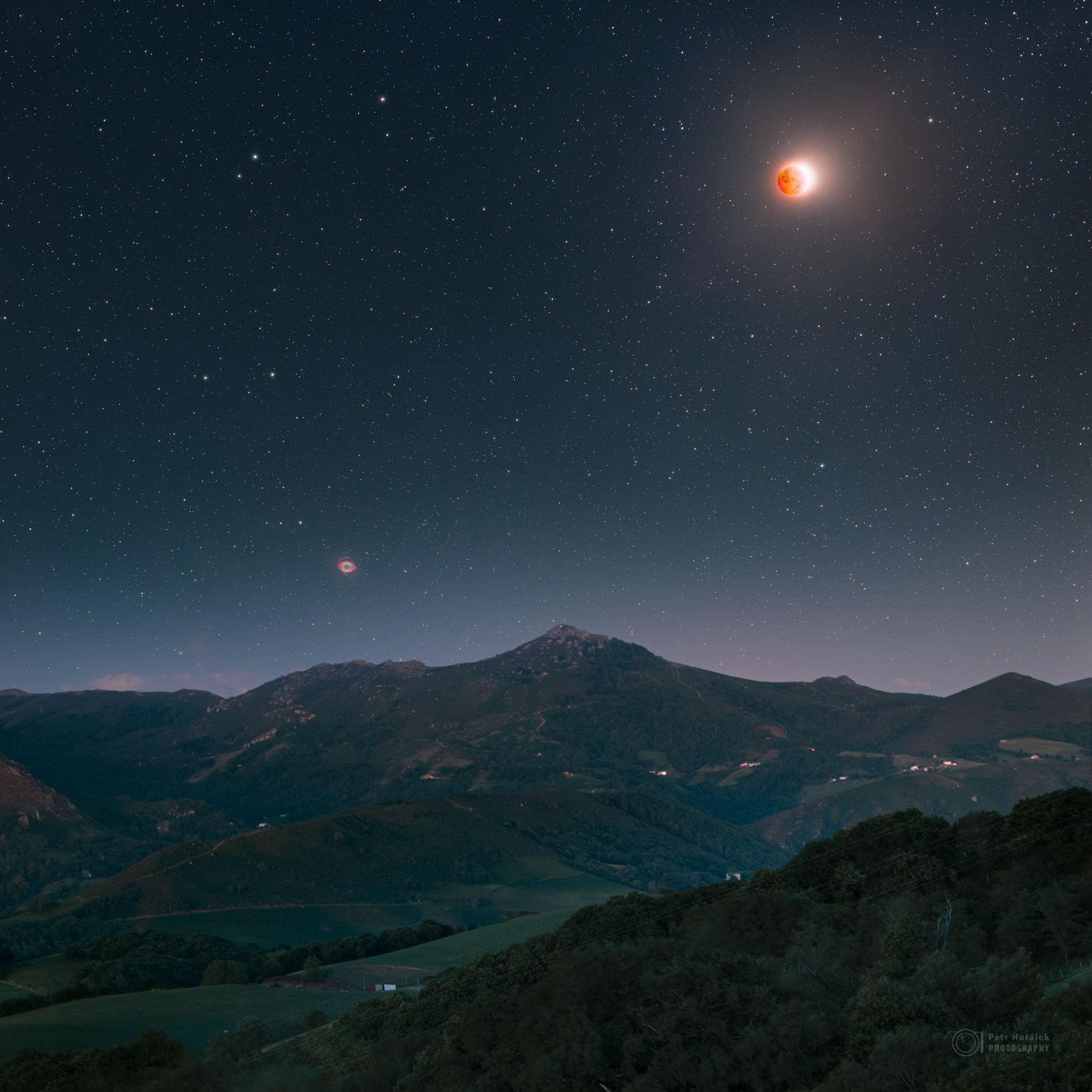
Eclipsed Moon, Helix, and Pyrenees

Eclipsed Moon, Helix, and Pyrenees – Annotated
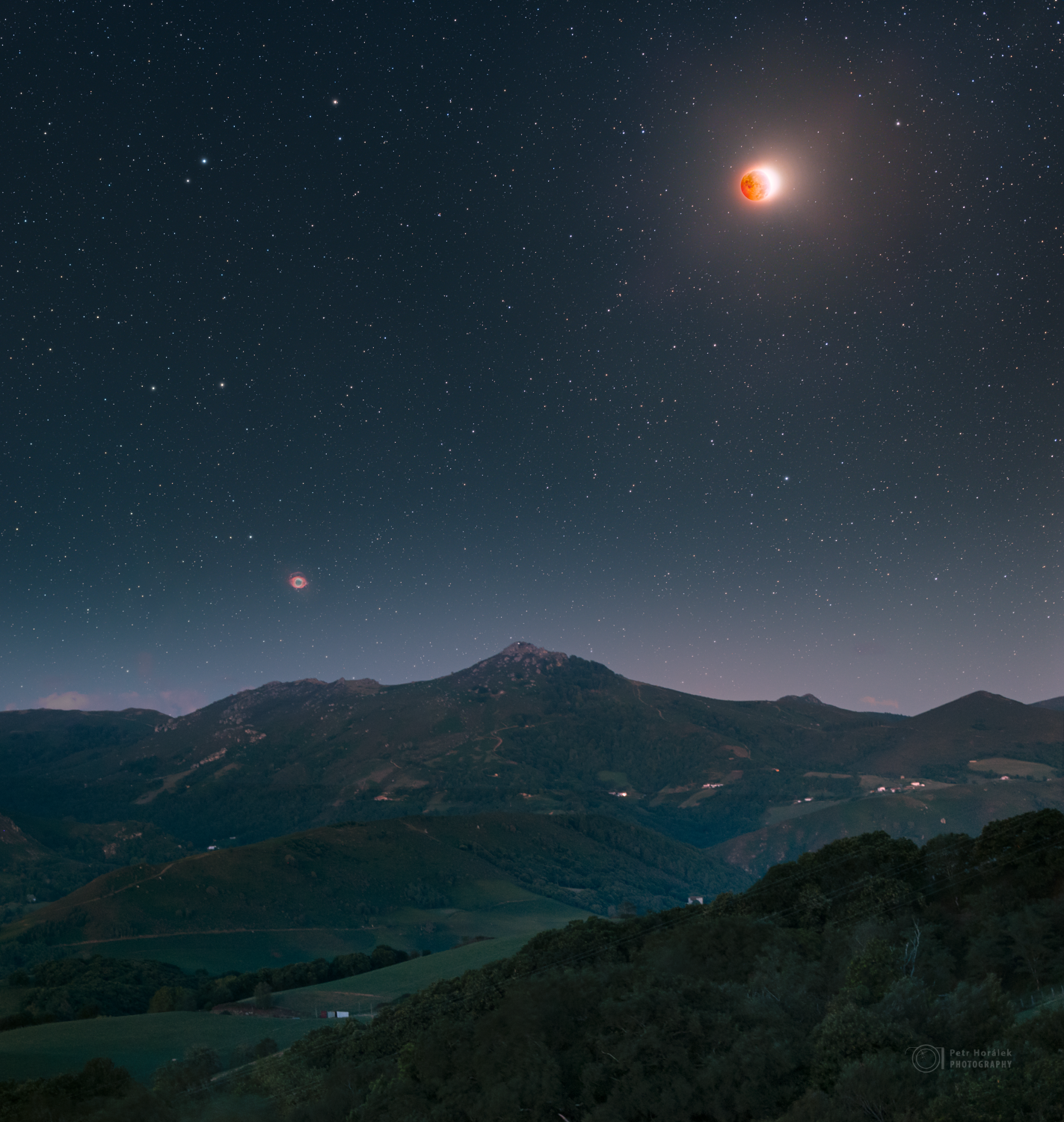
Eclipsed Moon, Helix, and Pyrenees – Vertical Cut
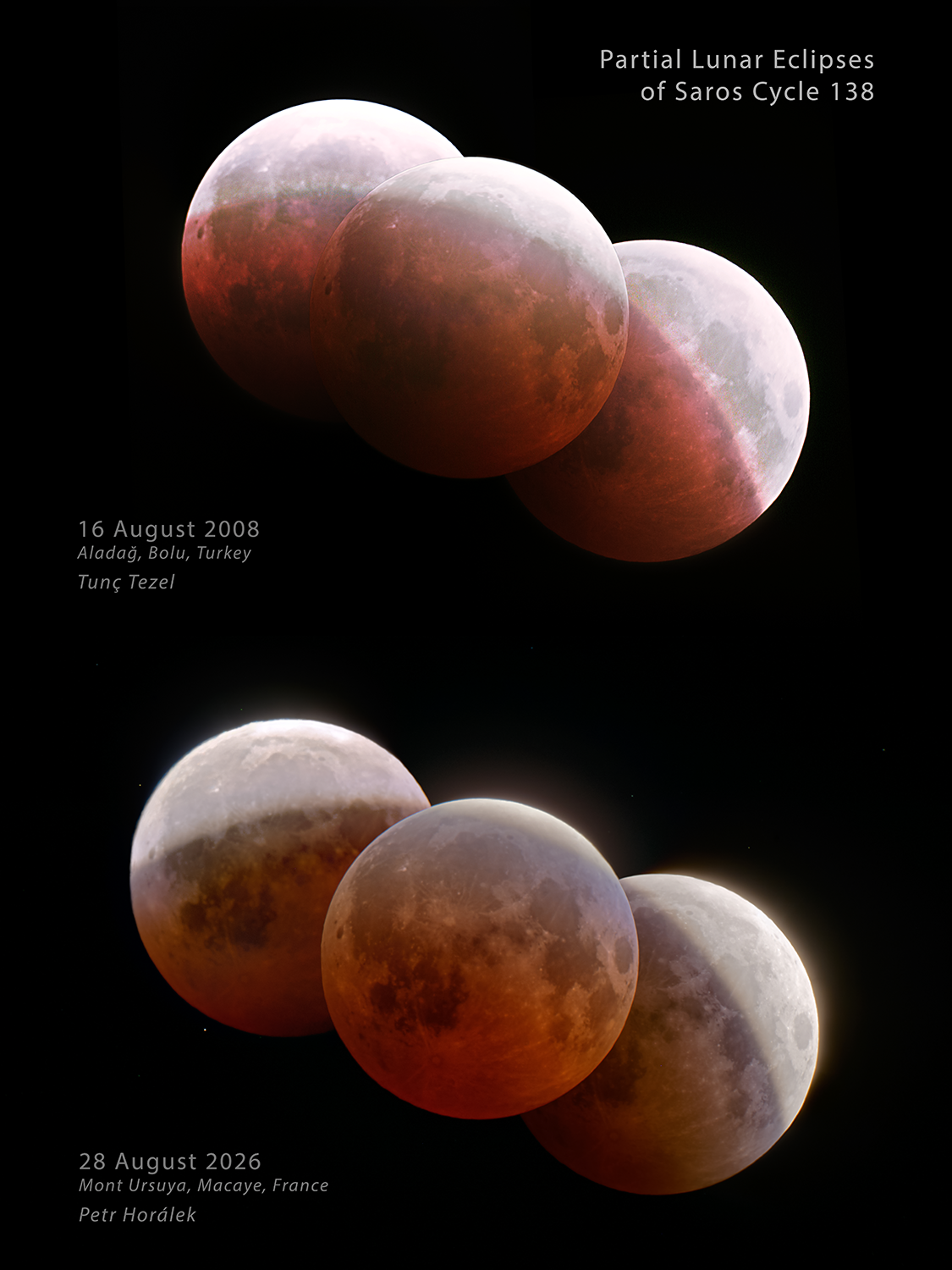
Two Eclipses of Saros 138
And one more think to mention. This eclipse is the last partial one of its series. Yes, it belongs to the Lunar Saros 138, which slowly moves into the deeper part of the Earth shadow. The next one occurs on 7 September 2044 and it will be total. Well, even the previous one was truly interesting. It occured on 17 August 2008 and it was unusually dark. Later then it was found out the Kasatoshi Volcano eruption polluted the air to such an extent that the volcanic dust subsequently partially obscured the part of the atmosphere through which sunlight passed to the Moon’s surface. The co-author is Tunç Tezel.

