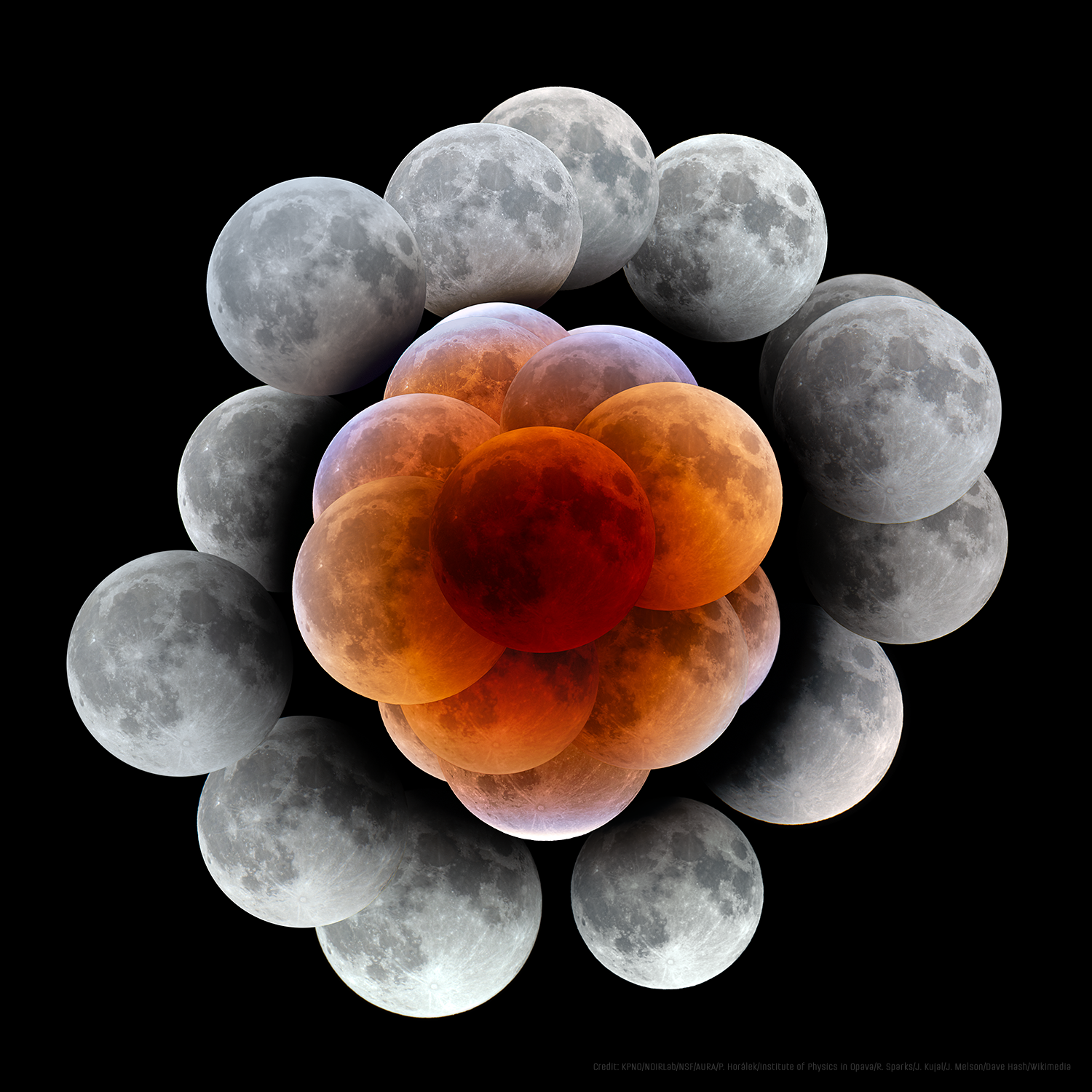
Lunar Eclipses Flower
This unusual mosaic is composed of random phases of all 18 significant lunar eclipses over the past decade (total, partial, and penumbral ones), also captured from Cerro Tololo and Kitt Peak National Observatory, and including the century’s longest one in the center of the mosaic (captured from Rhodes, Greece). The sizes and positions of the full moons are normalized to the unit angular diameter of the Earth’s shadow given by NASA to show the circular shadow of Earth. The composite shows different shades in the Earth’s shadow depending on the position of the Moon in it. The blue edge caused by short-wave radiation penetrating the lunar surface through the ozone layer is also visible. For most of them, I used Canon 6D or Nikon Z6III, 1000mm, f10, 4-6s exposures from Vixen GP-2 mount.
Full credit: KPNO/NOIRLab/NSF/AURA/Petr Horálek/Institute of Physics in Opava, Robert Sparks, Josef Kujal, John Melson/Dave Hash/Wikimedia
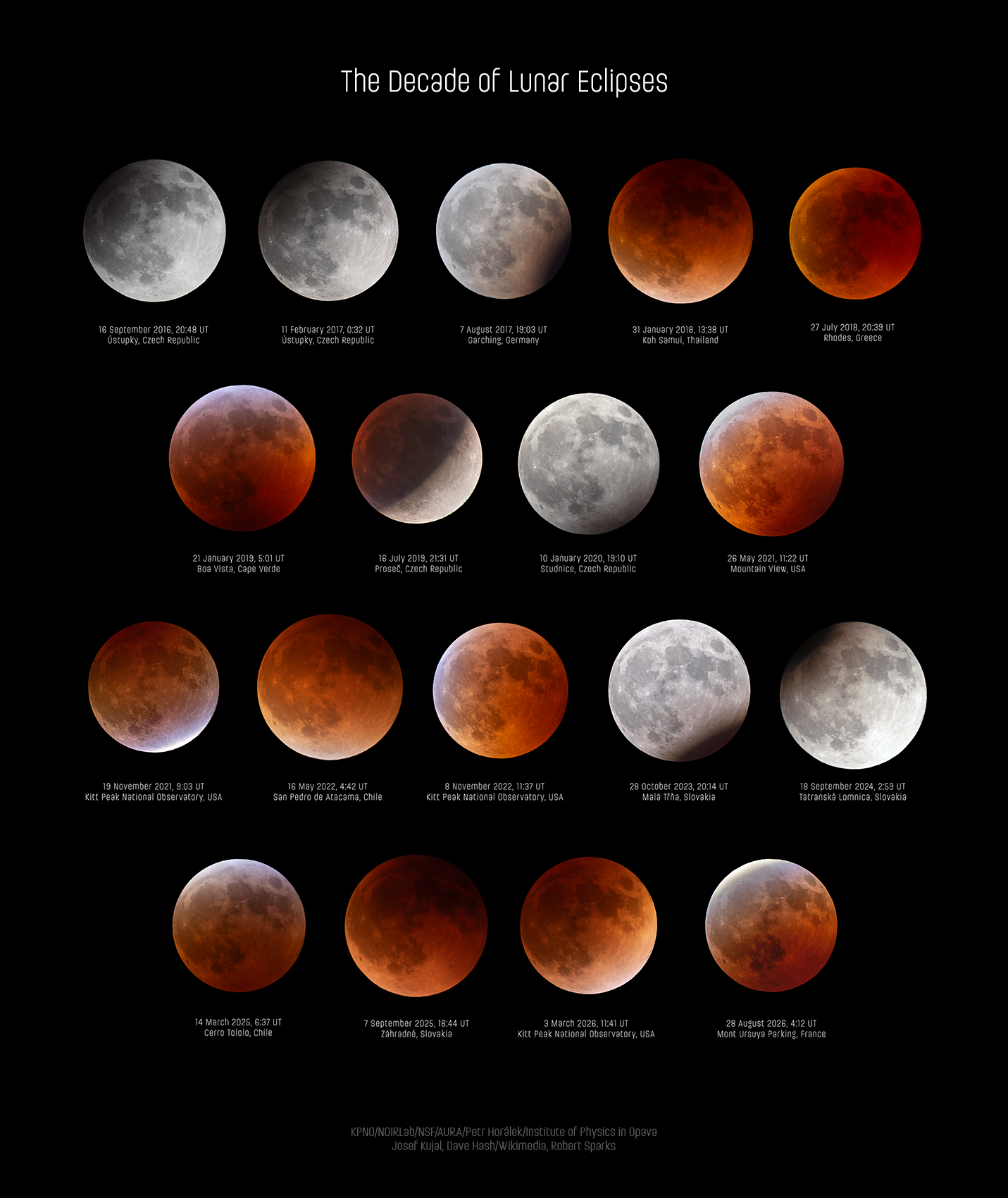
A decade of lunar eclipses. Credit: KPNO/NOIRLab/NSF/AURA/Petr Horálek/Institute of Physics in Opava, Josef Kujal, Dave Hash/Wikimedia, Robert Sparks
More about images used in this mosaic
This table contains more infomration about used images in the mosaic. Most of the eclipses were captured by me. Around period of COVID-19, however, I was not able to travel for the eclipses, so I used images taken by my colleagues who agreed with participating in this project. The table also shows, how the diameters of the lunar discs were normalized according to the actual distance of the Moon as well as the angular sizes of the Earth shadow in the sky during the particular eclipses.
| Eclipse Date | Location | Camera | Focal Length (mm) | Moon Distance (km) | Ratio (to largest on Jan 2019) | Shadow Ratio | Author | Note |
| 16 September 2016 | Ústupky, Czech Republic | Canon 6D | 1800 | 363 255 | 0,975623185 | 1,030436524 | Petr Horálek | |
| 11 February 2017 | Ústupky, Czech Republic | Canon 6D | 1000 | 372 703 | 0,950891192 | 1,086723919 | Petr Horálek | |
| 7 August 2017 | Garching, Germany | Canon 6D | 500 | 394 338 | 0,898721401 | 1,144403262 | Petr Horálek/ESO | |
| 31 January 2018 | Koh Samui, Thailad | Canon 6D | 1100 | 357 170 | 0,992244589 | 1,020087221 | Petr Horálek | |
| 27 July 2018 | Rhodes, Greece | Canon 6D | 1100 | 402 930 | 0,879557243 | 1,189734895 | Petr Horálek | Most distant from Earth |
| 21 January 2019 | Boa Vista, Cape Verde | Canon 6D | 1100 | 354 400 | 1 | 1,011134399 | Petr Horálek | Closest to Earth |
| 16 July 2019 | Proseč u Seče, Czech Republic | Canon 6D | 1100 | 397 263 | 0,892104223 | 1,15987979 | Petr Horálek | |
| 10 January 2020 | Studnice, Czech Republic | Canon 6D | 1100 | 367 719 | 0,963779408 | 1,064983444 | Petr Horálek | |
| 26 May 2021 | Mountain View, California | Canon 7D Mk II | 1490 | 356 010 | 0,995477655 | 1 | David Hash (Wikimedia, CC4.0) | Reference for normalized U. Radius |
| 26 May 2021 | East USA | SONY a7iii | 600 | 356 010 | 0,995477655 | 1 | John Melson | Reference for normalized U. Radius |
| 19 November 2021 | Kitt Peak National Observatory, USA | Canon Ra | n/a | 399 665 | 0,886742647 | 1,199720236 | Robert Sparks | |
| 16 May 2022 | San Pedro de Atacama, Chile | Canon Ra | 1100 | 355 740 | 0,996233204 | 1,018337731 | Petr Horálek, Josef Kujal | |
| 8 November 2022 | Kitt Peak National Observatory, USA | Canon Ra | 1000 | 386 260 | 0,917516699 | 1,137992039 | Petr Horálek/AURA/NOIRLab | |
| 28 October 2023 | Malá Třňa, Slovakia | Canon Ra | 1400 | 365 005 | 0,970945603 | 1,053644554 | Petr Horálek | |
| 18 September 2024 | Tatranská Lomnica, Slovakia | Canon Ra | 1400 | 356 053 | 0,995357433 | 1,002858256 | Petr Horálek | |
| 14 March 2025 | Cerro Tololo, Chile | Canon Ra | 1400 | 396 766 | 0,893221697 | 1,180816888 | Petr Horálek/AURA/NOIRLab | |
| 7 September 2025 | Záhradné, Slovakia | Nikon Z6III | 1250 | 367 940 | 0,963200522 | 1,048207496 | Petr Horálek, Josef Kujal | |
| 3 March 2026 | Kitt Peak National Observatory, USA | Nikon Z6III | 1400 | 379 756 | 0,933230811 | 1,105398826 | Petr Horálek/AURA/NOIRLab | |
| 28 August 2026 | Mount Ursuya, France | Nikon Z6III | 1400 | 379 756 | 0,910979045 | 1,128508772 | Petr Horálek, Josef Kujal |


