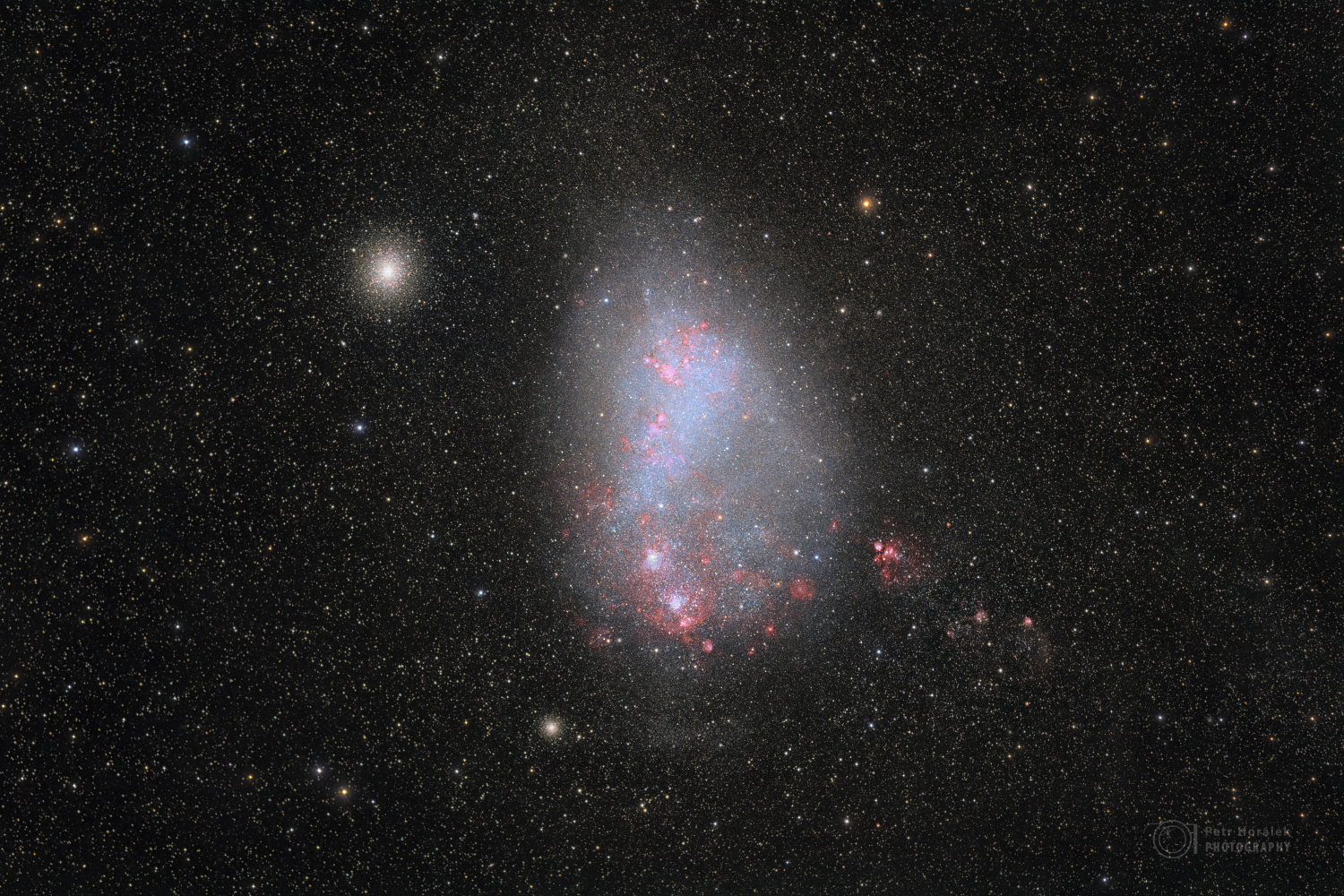
Four hours of Small Magellanic Cloud (crop)
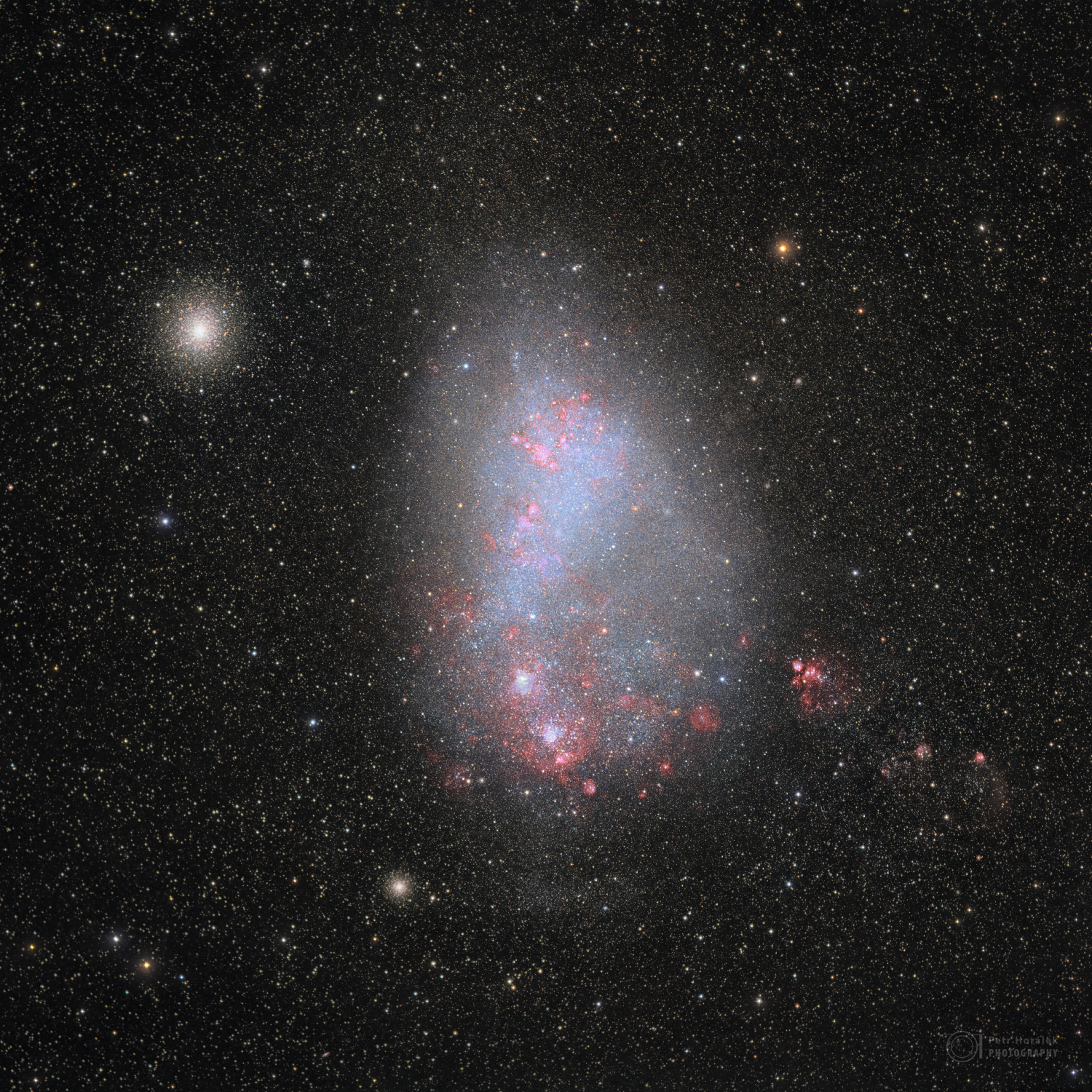
The last night of my 2025 stay at Cerro Pachón Observatory on (4-5 May 2025), where astronomers at Vera C. Rubin Telescope just started their amazing work, I tried to finish my longer-term photography project. The Small Magellanic Cloud (SMC) photography, which I actually started days sooner in Bolivia.
As NOIRLab says: Cerro Pachón is a mountain in the foothills of Chile’s Andes range. Northern Chile offers some of the clearest, driest, and darkest skies in the world. These conditions create ample opportunities for astrophotography and for addressing some of our biggest questions about the Universe. Such as capturing objects of deep Universe, like the Small Magellanic. With the Large Magellanic Cloud (LMC), they are the largest of the 60+ satellite galaxies of the Milky Way. Satellite galaxies orbit around a host galaxy and are usually smaller than their host galaxy. The SMC was once even a satellite galaxy of the LMC! Unlike most of the other satellite galaxies of the Milky Way, the SMC is actively forming stars at a rapid pace, a process revealed by the blue light in this image.
Four hours of Small Magellanic Cloud
The Small Magellanic Cloud (SMC) is a dwarf irregular galaxy located about 200,000 light-years from Earth, making it one of the closest galactic neighbors of the Milky Way. It spans roughly 7000 light-years across and contains several hundred million stars—far fewer than the Milky Way’s hundreds of billions. One of its most interesting physical features is its distorted, irregular shape, which is the result of strong gravitational interactions with both the Milky Way and its companion, the Large Magellanic Cloud. These interactions have triggered bursts of star formation, making the SMC rich in young, hot stars and glowing nebulae. It also has a relatively low metallicity (few heavy elements), which gives astronomers insight into conditions similar to those in the early universe.
Around the Small Magellanic Cloud, astronomers observe a number of globular clusters and stellar associations, though it has fewer than larger galaxies. Notable clusters include NGC 121, one of the oldest known clusters in the SMC, and 47 Tucanae, which, although actually part of the Milky Way, appears close to the SMC in the sky. The region is also surrounded by the Magellanic Bridge, a stream of gas and stars connecting it to the Large Magellanic Cloud, and the Magellanic Stream, a long tail of gas trailing behind both galaxies. These structures provide clear evidence of ongoing gravitational interaction and material exchange, making the SMC a key object for studying how galaxies evolve through interaction.
Used Canon Ra, Tamron 70-200mm@200mm, f2.8, ISO 3200, 30s exposures, 3.9 hours total integration time.
Full credit: NOIRLab/NSF/AURA/P. Horálek (Institute of Physics in Opava)
See also Six hours of Large Magellanic Cloud.
České zamyšlení:
Škoda, že takový obrázek nikdy nemůže zaujmout širší publikum. Protože tohle nebyla žádná sranda. Ale fakt pořádná roubírna!
Co že to teda vlastně vidíte? Pár tisícovek teček, nějaké šmouhy, troška červené barvy. Ano, jedním klikem můžete něco takového upatlat zaměstnáním nějaké vhodné umělé moudrosti. Jenomže to byste pak vyprodukovali jen ilustrační obrázek. Toto je totiž fotka. Fotka reálného objektu. Fotka, kterou jsem exponoval přes 4 hodiny. Ano, čtete dobře, PŘES 4 HODINY!
Na snímku vidíte droboučkou galaxii známou jako Malé Magellanovo Mračno, která leží asi 200 000 světelných let od Země a je patrná nedaleko jižního nebeského pólu i pouhýma očima. Teleskopy velkých observatoří pořídily její portrét mnohem krásněji, ale já jsem chtěl přijmout a vyzkoušet jednu výzvu: Dá se to nafotit i klasicky na běžně dostupnou techniku? Tak jako dá, ale chce to 1) dokonale tmavou noční oblohu, 2) dostatečně ustavenou aparaturu, co odolá i silnějšímu větru, 3) trošku té matematiky ve službách astrofotografie.
To první a třetí jsem měl, to druhé bylo dost na hraně. Je tomu zhruba rok, kdy jsem ta data pořídil, a to konkrétně na observatoři Cerro Pachón v poušti Atacama v Chile. A vichr fičel fakt slušný. Nakonec jsem celou těžkou aparaturu s 200mm objektivem “zašil” do závětří mohutné kopule Gemini South (schválně zaměstnějte strejdu Googla, abyste zjistili, jak mohutné) a nechal aparát cvakat dílčí expozice po dobu zhruba 4 hodin.
Výhoda této galaxie je, že na jihu nezapadá, ale přesto barevné nebe v důsledku silného airglow, přirozeného záření atmosféry, nemalou výzvu ve zpracování přineslo. Samotné zpracování zabralo ještě asi 40 hodin čistého času – zkušení astrofotografové zhruba tuší, co všechno za tím stálo. No a vy nezkušení se teď můžete pokochat detailním a hlubokým portrétem jedné ze sousedních galaxií, kterou zleva ještě doplňuje okuskvostná kulová hvězdokupa 47 v souhvězdí Tukana.

